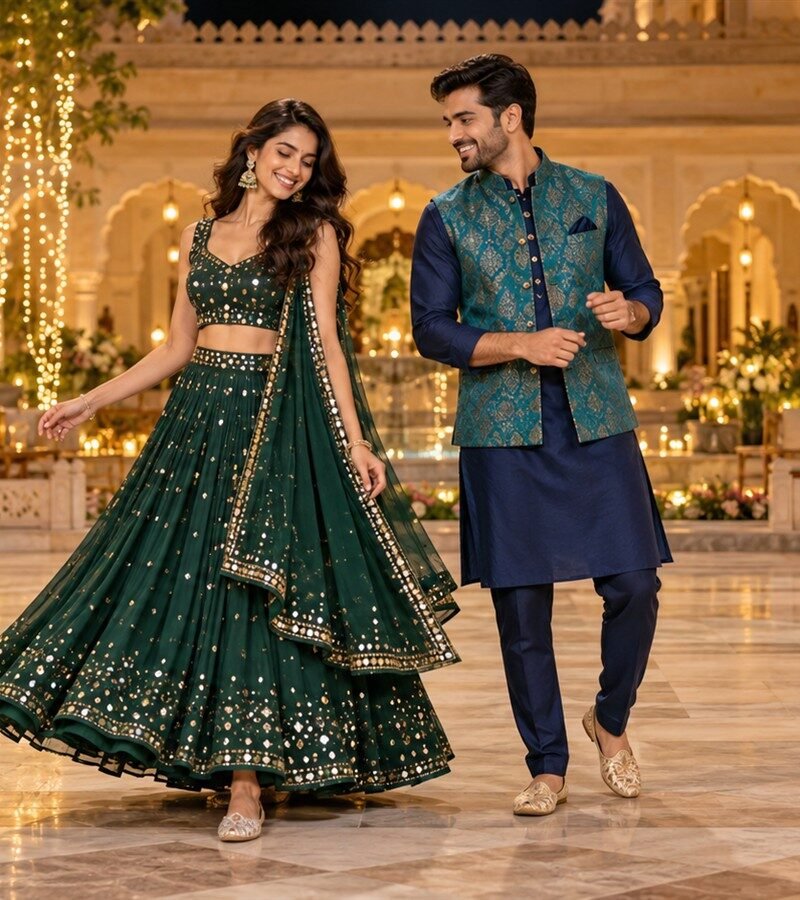
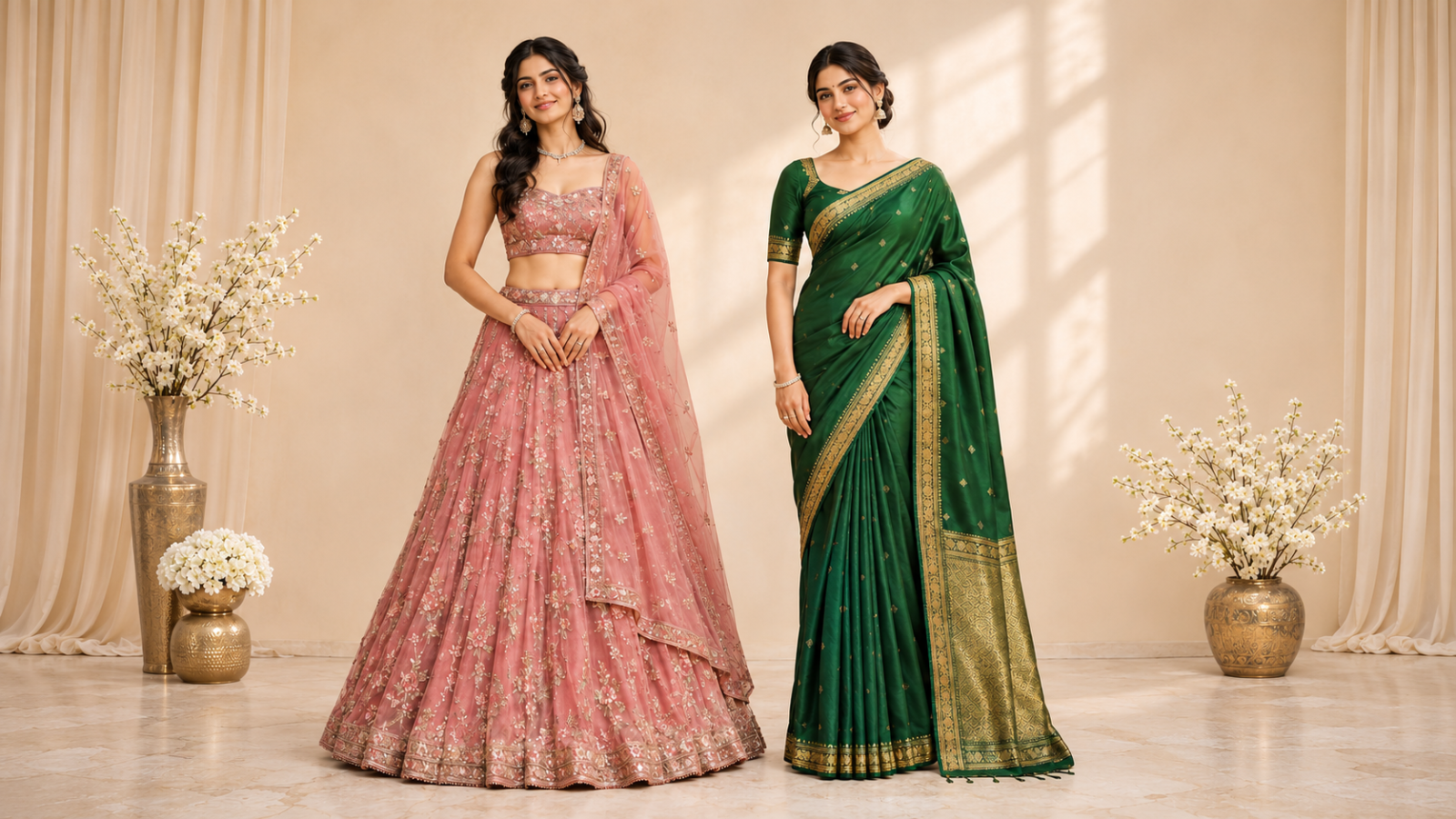

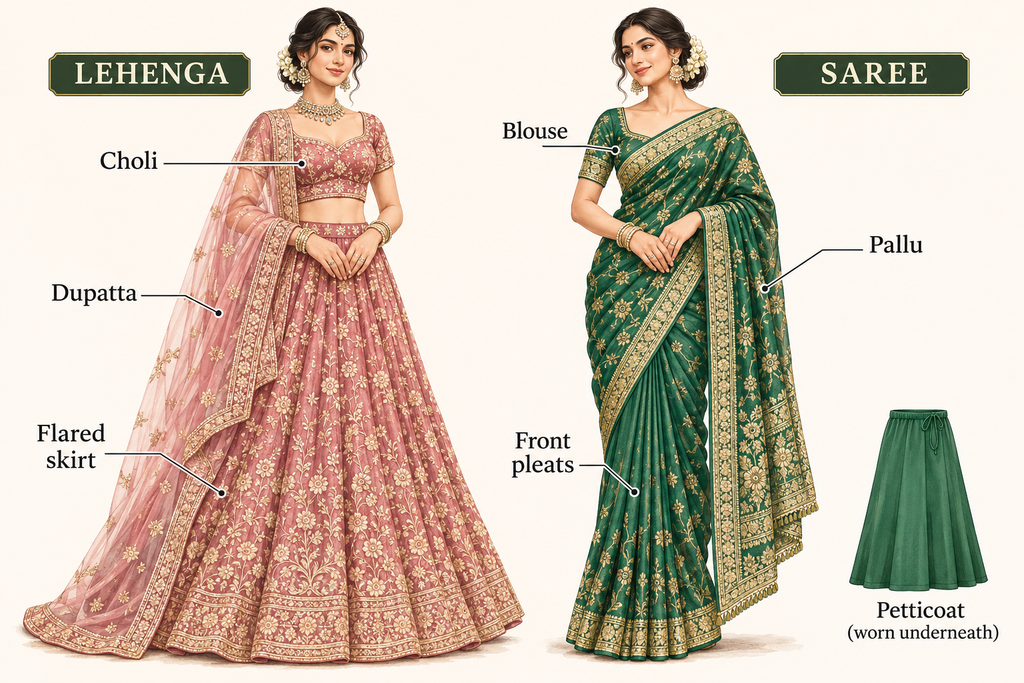
A lehenga is a three-piece outfit: a long, flared skirt, a fitted blouse called a choli, and a dupatta. A saree is a single unstitched length of fabric, roughly 4 to 8 metres long, that is wrapped around the waist, pleated and draped over the shoulder, worn with a blouse and a petticoat underneath.
That difference decides most things. A lehenga goes on like a skirt and is easier for first-timers, dancing and long events. A saree takes practice or help to drape, but suits every body and size, can be re-draped many ways, and is often lighter in hot weather. For most first-time guests, a lehenga is the easier choice. For anyone who already drapes, or who wants a classic look for a ceremony, a saree is hard to beat. The comparison below covers comfort, cost, occasions, brides and guests, and the questions people ask most.
Lehenga vs saree at a glance
| Lehenga | Saree | |
| What it is | Stitched skirt, choli and dupatta | Unstitched length of fabric, about 4.1 to 8.2 m, worn with a blouse and petticoat |
| Getting dressed | Step in, fasten, pin the dupatta | Pleating and draping; needs practice or help |
| Help needed | Rarely, except for heavy bridal pieces | Often, for first-timers and formal drapes |
| Movement and dancing | Easy, especially in lighter fabrics | Fine once pinned; pleats can loosen |
| Fit | Skirt and choli are made to measurements | One size fits all; only the blouse is fitted |
| Weight | Can be heavy (layers of can-can, embroidery) | Usually lighter, depending on fabric |
| Hot weather | Warmer, especially with lining | Often cooler in cotton, chiffon or georgette |
| Packing and travel | Bulky, especially flared skirts | Folds flat |
| Re-wearing | Mix and match the three pieces | Change the blouse or the drape |
| Typical events | Sangeet, mehndi, receptions, brides | Ceremonies, receptions, formal events, brides |
What is a lehenga?
A lehenga, also called a ghagra or chaniya, is a long, flared skirt worn with a fitted choli and a dupatta. The set is often called a lehenga choli. According to Wikipedia, it evolved from the three-piece clothing worn by women in ancient India, which combined a lower garment, a chest band and a veil.
Lehengas are associated with North and West India, including Rajasthan, Gujarat and Punjab, where they are worn for festivals such as garba and for weddings. They are also the main bridal garment in Pakistan. Wikipedia’s article on Pakistani clothing notes that most Pakistani brides wear lehengas, with either a short choli or a longer kameez on top.
Lehengas vary widely: a light georgette lehenga for a sangeet, a heavily embroidered silk or velvet one for a bride. The skirt is often stiffened with can-can, a layered net underskirt, which adds volume and weight.
What is a saree?
A saree, or sari, is an unstitched length of fabric about 4.5 to 9 yards (4.1 to 8.2 m) long and 60 to 120 cm wide. The word comes from the Sanskrit śāṭī, meaning a strip of cloth. It is worn over a petticoat, an underskirt into which the pleats are tucked, and a fitted blouse.
The most common drape today, the nivi, originated in the Deccan region. In it, one end is wrapped around the waist, the middle is pleated at the front, and the decorated end, the pallu, falls over the left shoulder. It is only one of many: Wikipedia records more than 80 ways of wearing a saree, and the textile historian Rta Kapur Chishti documented 108 in her book Saris: Tradition and Beyond.
The saree and the lehenga in Pakistan
Most of what you read about this choice is written from an Indian fashion perspective. In Pakistan the picture is different. The shalwar kameez is everyday wear, the lehenga dominates bridal wear, and the saree has had a more complicated history.
Writing in Dawn in 2021, Mariam Ali Bokhari described how General Zia-ul-Haq’s government issued directives from 1980 on how women government employees should dress, followed by a 1983 ban on saris for government officials. Outside communities such as Parsi and some Sindhi families, she wrote, the sari became “relegated to school farewells and weddings”. A 2018 Dawn piece by Shazia Hasan found that many women preferred shalwar kameez as “far easier to manage”, but quoted a Karachi seller who said young women were still buying saris.
Bokhari also reported “a revival of saris” among urban women. Today the saree is worn at weddings and formal events in Pakistan, particularly in Karachi and Islamabad, while the lehenga, the sharara and the gharara remain the most common choices for brides. If you are attending a Pakistani wedding, either works as a guest. Our guide to what to wear to a Pakistani wedding covers each event.
Which is more comfortable?
It depends on the fabric more than the garment, but some patterns hold.
- A lehenga feels more secure for most first-time wearers. Nothing can unravel, the skirt is fastened at the waist, and you can walk, sit and dance without thinking about pleats. The trade-off is weight: a full skirt with can-can and heavy embroidery can be tiring over a long evening.
- A saree is often lighter and cooler, especially in chiffon, georgette or cotton, and it adjusts to your body. The trade-off is security: until you are used to it, you may worry about the pleats or the pallu slipping. Good pinning solves most of this.
- For dancing, a light lehenga or a sharara is the easiest option. A saree works if it is well pinned or pre-draped. Our sangeet guide has more on dancing in Indian wear.
Choosing as a guest
- First Indian or Pakistani wedding: a lehenga, a sharara set or a pre-draped saree. All three are hard to get wrong.
- Sangeet, mehndi or garba: a light lehenga. You will be moving a lot.
- Religious ceremony: either, in a modest cut. A saree in silk or a lehenga with a longer choli both suit a ceremony. Keep a dupatta or the pallu available to cover your head if needed.
- Reception or walima: either. Sarees in georgette, chiffon or net are common reception choices, as are lighter lehengas.
- Hot or outdoor events: a saree in a light fabric, or a lehenga without heavy lining.
- Travelling: a saree packs flat; a flared lehenga takes up a suitcase.
Whichever you choose, avoid anything that could be mistaken for the bride’s outfit, particularly a heavily embellished red.
Choosing as a bride
Brides choose both. Wikipedia describes the sari and the lehenga choli as the most popular bridal garments in India, and most Pakistani brides wear lehengas. A few practical points beyond style:
- Weight and duration. Bridal lehengas can be very heavy. Ask for the finished weight and try it on for at least an hour.
- Rituals. If a ceremony involves sitting cross-legged or walking around a fire, try sitting and walking in the outfit before the day.
- Help on the day. A bridal saree needs a skilled draper; a bridal lehenga needs someone to set the dupatta. Plan for either.
- After the wedding. A lehenga’s choli and dupatta can be re-worn separately; a bridal saree can be re-worn with a new blouse.
Fit and body shape
There is no rule that one garment suits a body type better. What changes is how each is fitted:
- A lehenga is cut to your waist, hip and length measurements, and the choli to your bust. Fit is precise, so alterations matter. The flare, the waist height and the length of the choli all change the proportions.
- A saree adjusts to almost any body and size, and to pregnancy, because the fabric is draped, not cut. Only the blouse needs fitting. The drape, where the pleats sit and how the pallu falls, changes the line.
Choose the one you feel comfortable moving in.
Cost, renting and re-wearing
Prices for both run from affordable ready-made pieces to bridal couture. What drives cost is the fabric, the embroidery and whether the piece is handwoven or hand-embroidered, not the garment type.
- Lehenga: you pay for stitching and fitting, and alterations are usually needed for ready-made pieces. The three separate pieces can be re-styled later.
- Saree: no stitching except the blouse and petticoat. One saree can be worn many ways with different blouses.
- Renting: rental services for South Asian formalwear operate in the US, UK and Canada. Lehengas are easier to rent because they are sized; for a saree, you will still need a blouse that fits.
Lehenga-style sarees and pre-draped sarees
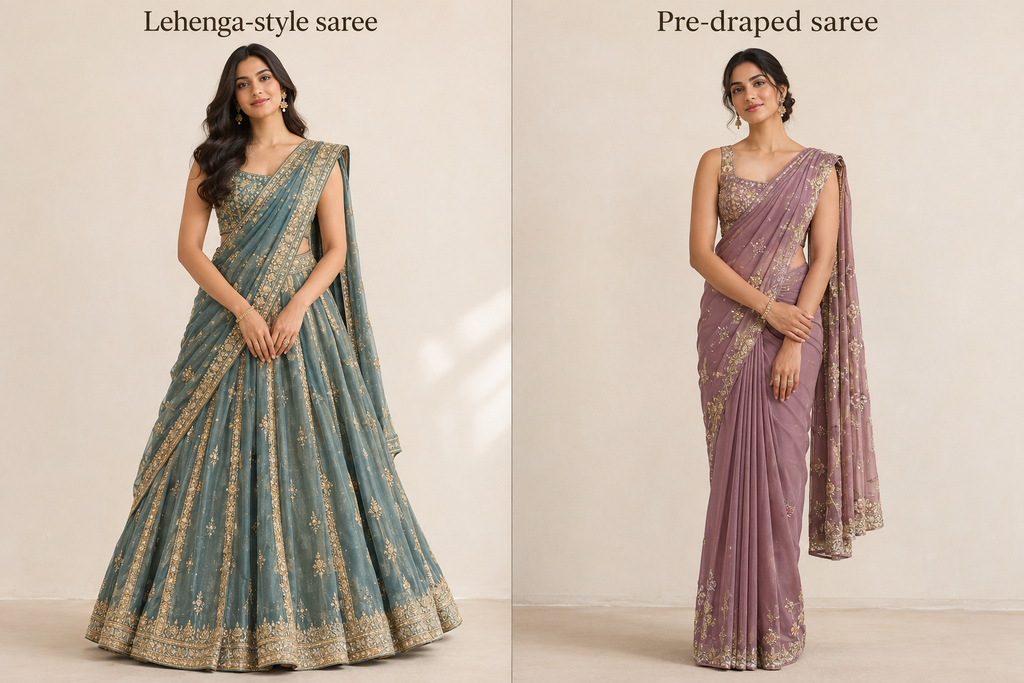
If you want the look of one with the convenience of the other, two hybrids exist:
- Lehenga-style saree: a saree draped without front pleats, wrapped around the waist with panels or gota borders creating a flared, lehenga-like silhouette. It is usually 4.5 to 5.5 metres long.
- Pre-draped saree: a saree that is already pleated and stitched. You step in, fasten it and arrange the pallu, so there is nothing to drape.
Frequently asked questions
Should I wear a lehenga or a saree to a wedding?
Both are appropriate. Choose a lehenga for dancing-heavy events and if you have never draped a saree; choose a saree for ceremonies, receptions or hot weather, or if you are comfortable draping. Avoid bridal-looking red in either.
Which is more comfortable, a saree or a lehenga?
A lehenga feels more secure and is easier to move in for most first-time wearers. A saree is often lighter and cooler, and is comfortable once you are used to it and it is well pinned.
Can a saree be worn as a lehenga?
Yes, with a lehenga-style drape: the saree is wrapped around the waist without front pleats so it flares like a skirt, and the pallu goes over the shoulder. Some sarees are made specifically for this drape.
Can I wear a lehenga if I’m not Indian?
Yes. Hosts at Indian and Pakistani weddings generally welcome guests in South Asian dress. If you are unsure, ask the couple, or ask a friend to help you choose and dress.
Which is easier to wear for a beginner?
A lehenga. It goes on like a skirt; only the dupatta needs pinning. If you want a saree but have never draped one, try a pre-draped saree.
What do you wear under a lehenga or a saree?
Under a saree, a petticoat and a fitted blouse. Under a lehenga, the skirt usually has its own lining and can-can; the choli is often lined, and many are made with padding or built-in support, so choose undergarments to match the blouse’s neckline and back.
Is a lehenga more expensive than a saree?
Not necessarily. Both range from affordable to couture. Lehengas involve more stitching and fitting; sarees can be costly if handwoven, such as fine Banarasi silk.
What is the difference between a lehenga and a ghagra?
They are largely the same garment, a long, flared skirt. “Lehenga” is the term most used by designers and shops; “ghagra” and “chaniya” are regional names.
The short version
A lehenga is a stitched skirt, choli and dupatta; a saree is a single draped length of fabric. Pick a lehenga if you want something easy to put on and dance in; pick a saree if you can drape it (or have help), want a lighter outfit, or love its versatility. Both work for guests and brides. In Pakistan, the lehenga dominates bridal wear while the saree is enjoying a revival.