
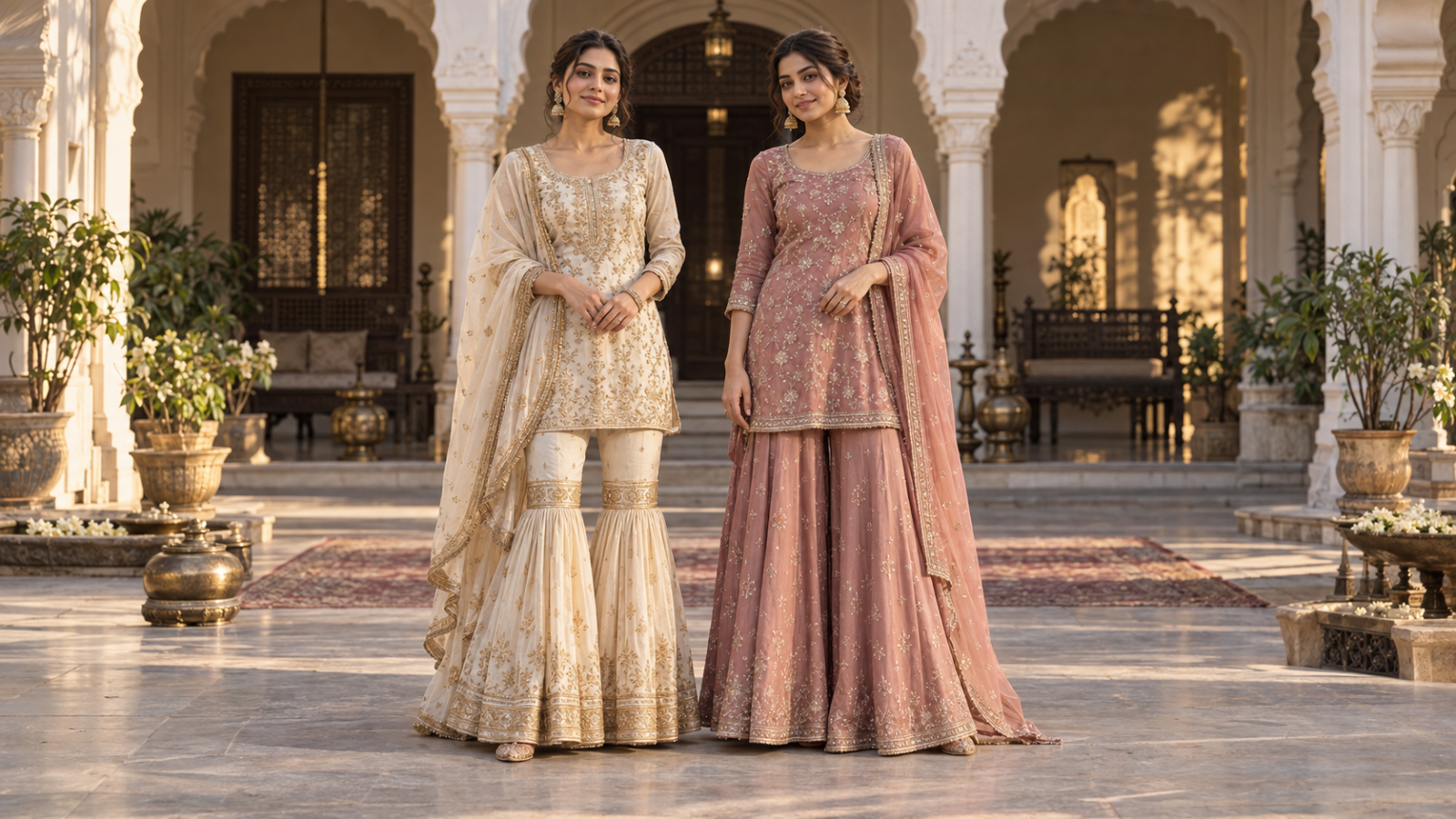

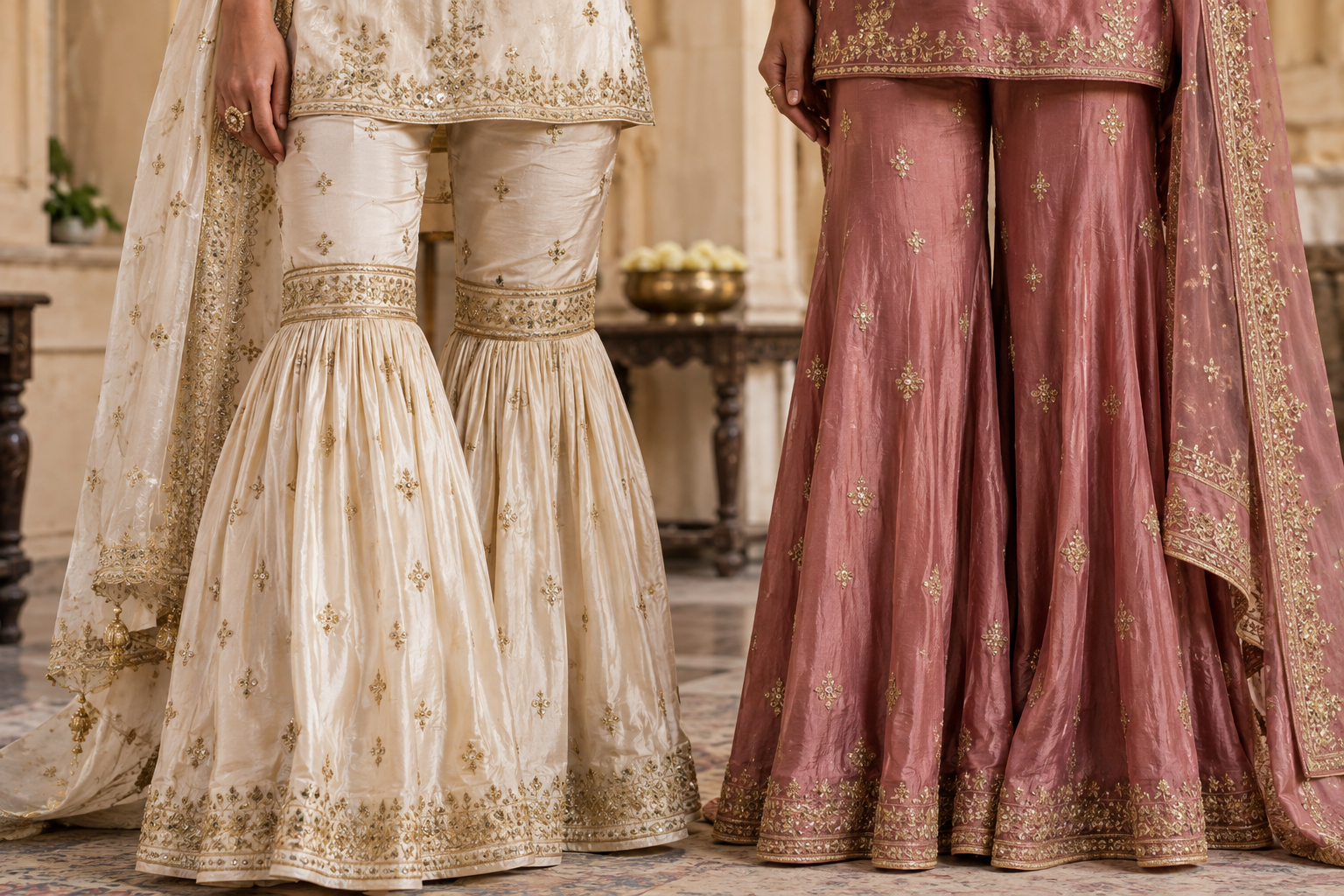
A sharara and a gharara are both wide, flared trousers worn with a kurti or kameez and a dupatta, and both are divided into two legs. The difference is at the knee. A gharara is fitted from the waist to the knee, where it is joined to a heavily gathered lower section, and that join is usually hidden under a decorative band. A sharara has no knee joint: the fabric flares in one continuous line to the hem.
So the quickest test is this: if there is a seam or embellished band running around the knee, it is a gharara. If the flare flows down without one, it is a sharara.
That one detail carries a lot of history. The gharara came out of the courts and households of 19th-century Awadh. The sharara is a later, simpler adaptation. Below you will find a side-by-side comparison, how each garment is built, how the palazzo and lehenga fit in, and how to choose between them for a wedding or Eid.
Sharara vs gharara at a glance
| Feature | Gharara | Sharara |
|---|---|---|
| Basic shape | Fitted to the knee, then gathered and flared below it | Flared without a break, with no knee joint |
| Knee detail | A joint at the knee, traditionally covered with a gota band; the knee area is often heavily embroidered | No seam or band at the knee |
| Legs | Two legs (divided trouser) | Two legs (divided trouser) |
| Movement | Flare starts at the knee, so the volume swings below it | Volume falls in one line, closer to a full skirt when standing still |
| Fabric (traditional) | Over 12 metres per leg in traditional versions, often silk brocade | Varies by design; there is no fixed traditional measure |
| History | Awadh (present-day Uttar Pradesh), era of the Nawabs; everyday wear for many Muslim women of the region in the late 19th and early 20th centuries | A later adaptation; historian Rana Safvi describes it as “a cross between a gharara and a lehnga” |
| Where you see it today | Weddings, especially nikkah, baraat and heritage-themed events in Pakistan, India, Bangladesh and the diaspora | Weddings, mehndi, Eid and festive events |
Why people mix them up
The two garments look alike in photographs, especially when a long kameez covers the knee, which is exactly where the difference sits. Shops and even fashion media use the words loosely. In January 2022, Dawn Images headlined a Pakistani actor’s bridal look as “a traditional gharara”, while the designer’s own caption, quoted in the same piece, called it a “sharara set”.
Online guides do not agree either. Some describe a sharara as flaring from the waist, others from the hips or the knee. The flare point varies from tailor to tailor, so it is an unreliable test. The knee joint is not: either the garment has one or it does not.
Search behaviour reflects the confusion. In Google Keyword Planner data for October 2025 to September 2026, “sharara” averaged 8,100 monthly searches in the US against 1,900 for “gharara”, and 5,400 against 1,600 in the UK. “Sharara” is the more familiar word abroad, so it often gets used for both.
What is a gharara?
A gharara is a traditional outfit made up of a short kurti, a dupatta and, most importantly, a pair of wide-legged trousers ruched at the knee so that they flare out dramatically. It originated in the Awadh region, in present-day Uttar Pradesh, during the era of the Nawabs.
In the late 19th and early 20th centuries it was everyday wear for many Muslim women across the Hindi-Urdu belt. It became a familiar sight in early Pakistan and Bangladesh in the 1950s and 1960s, when public figures such as Fatima Jinnah and Begum Ra’ana Liaquat Ali Khan wore it. It is no longer daily wear, but it remains a wedding staple in Pakistan, India and Bangladesh.
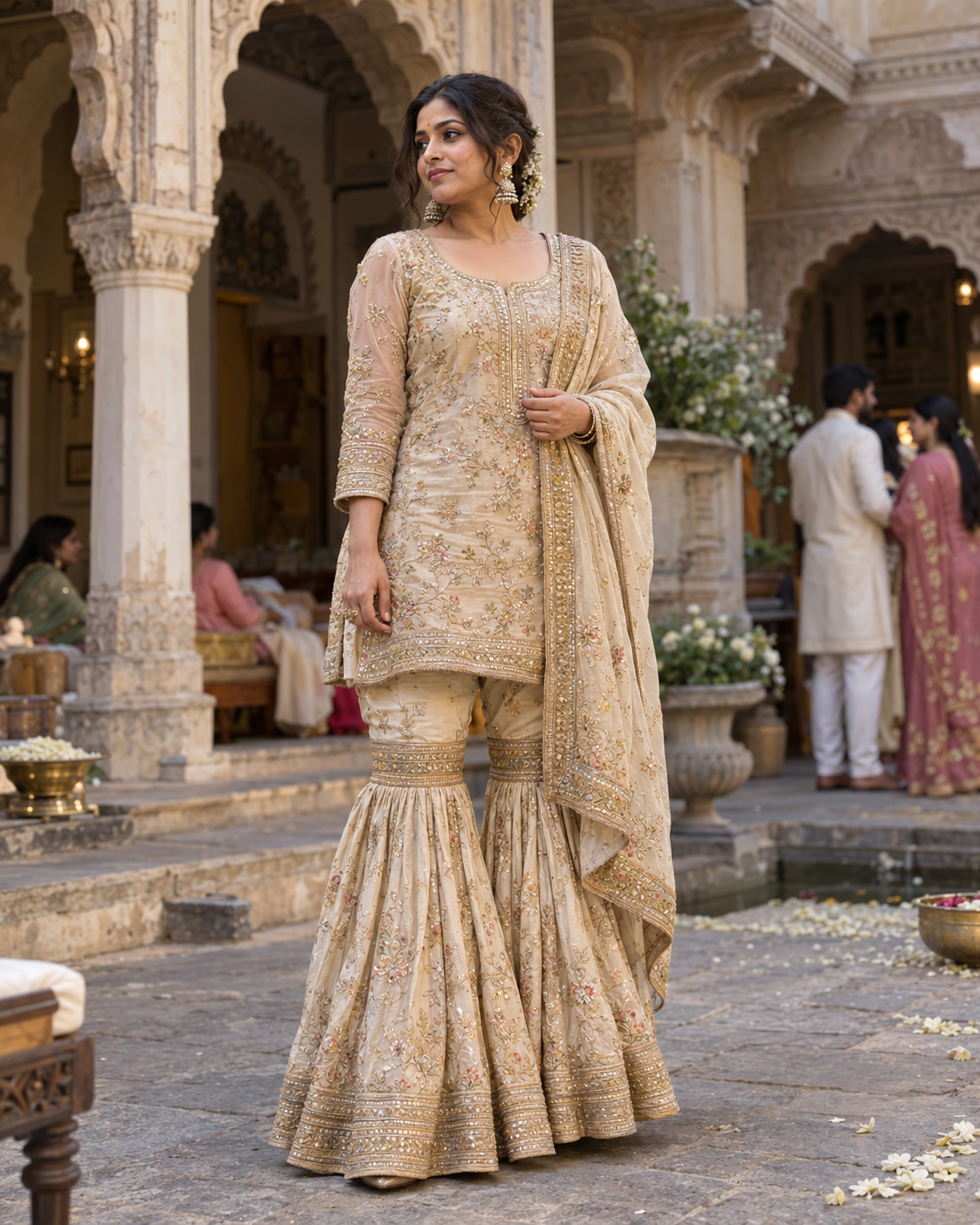
How a gharara is built
Rana Safvi, a historian who writes about Awadh’s culture and has photographed herself in her grandmother’s farshi gharara, more than a hundred years old, describes its anatomy in detail:
- Paat or kunda: the upper, fitted part of each leg.
- Gote: the knee area, often embroidered in zari and zardozi.
- Rumaali or miyaani: a piece of cloth that separates and joins the two parts of the leg.
- Nefa: the waist channel for the drawstring or kamarband that holds the garment up.
- Lachka gota: a metallic lace stitched over the knee joint to hide it. Safvi notes it was once real silver and gold work, and that this joint is what differentiates a gharara from a sharara.
Traditional ghararas use a great deal of fabric: over 12 metres for each leg, often in silk brocade. A 1962 issue of Yojana, published by India’s Ministry of Information and Broadcasting, describes the “gharara or bara paincha” worn by the Begums of Lucknow as sometimes requiring 36 yards of cloth.
What is a farshi gharara?
“Farshi” means “of the floor”. The farshi pajama, worn in the courts of Oudh (Awadh), fell straight to the ankles and then flared out so that it trailed on the floor, historically using 9 to 15 yards of cloth. A wearer would gather the trailing fabric in her left hand to walk. The name “farshi gharara” for this style is relatively recent; the term was not used before the mid-20th century. Shorter versions are still made for weddings by brides who want a heritage look.
What is a sharara?
A sharara is a pair of flared, two-legged trousers that has no knee joint and no gathering at the knee. Rana Safvi describes it as an adaptation for modern times, which became common when fabric grew expensive and fewer tailors were available to stitch the gharara, and calls it “a cross between a gharara and a lehnga”.
Without the knee joint, a sharara is simpler to construct and easier to cut in lighter fabrics. That is one reason it shows up across bridal, festive and ready-to-wear collections, usually paired with a short kurti or a longer kameez and a dupatta.
How to tell them apart in ten seconds
- Look at the knee. A horizontal seam or embellished band around the knee means gharara. No band means sharara.
- Check the upper leg. A gharara is close-fitting from the waist to the knee. A sharara is usually looser above the knee as well.
- Watch it move. On a gharara, the volume swings from the knee down. On a sharara, it falls in one line from higher up.
- Lift the kameez if you are shopping. Long tunics hide the knee, which is the one detail that matters. Ask the seller directly whether the piece has a knee joint.
Sharara vs gharara vs palazzo
This is one of the most common follow-up questions. Palazzo pants are, in Merriam-Webster’s definition, “extremely wide-legged pants for women”, a term first recorded in English in 1956. Rana Safvi places the palazzo between the sharara and the straight pyjama: it ranges from a straight wide leg to something with more gather, close to a sharara.
In practice, a palazzo is the everyday option: wide but usually far less voluminous, and without the knee joint of a gharara. A sharara is fuller and more formal. A gharara is the most structured of the three.
And the lehenga?
A lehenga is a skirt, not a trouser. A sharara and a gharara are both divided into two legs, so they move like a skirt but let you walk, sit and dance as you would in trousers. If an outfit has no division between the legs, it is a lehenga or a skirt, whatever the label says.
Which should you wear?
Neither garment is tied to a particular occasion by rule, but some practical points help you choose.
- For a nikkah, baraat or heritage-themed wedding: the gharara carries the stronger link to Awadhi and early-Pakistan bridal tradition, which is why many brides and close family members choose it for formal events.
- For a mehndi, sangeet or dholki: events with a lot of dancing reward a garment that moves easily. Try the outfit on and walk, sit and turn in it before the day, whichever style you pick.
- For Eid and festive dinners: a sharara in a lighter fabric is a common choice, and easier to wear for long hours.
- As a wedding guest: either works. The usual guest etiquette applies: avoid colours and levels of embellishment that could be mistaken for the bride’s outfit. Our guide to Pakistani bridal dresses explains what brides typically wear at each function.
Before you buy or order
- Measure waist to knee. A gharara’s joint should sit at your knee. If it sits too high or too low, the flare looks off and the garment is harder to walk in.
- Ask about weight. Traditional ghararas use a lot of fabric and heavy embroidery at the knee. Ask for the finished weight if you plan to wear it for a long event.
- Check the lining and the gota. On a gharara, the knee band is the focal point, so look at the quality of the gota and embroidery there.
- Plan your footwear early. Hem length depends on your heel height, so take your shoes to the fitting.
Frequently asked questions
Is a sharara two-legged?
Yes. A sharara is a divided trouser with two legs, as is a gharara. The width of each leg makes both look like a skirt when you stand still. A lehenga, by contrast, is a skirt.
Is sharara worn by Muslims?
Neither the sharara nor the gharara is religious dress. The gharara’s history is closely tied to the Muslim courts and households of Awadh and to early Pakistani public life. Today both styles are worn at weddings and festive events by women of many backgrounds in South Asia and the diaspora.
What is the difference between a palazzo, a sharara and a gharara?
A palazzo is wide-legged everyday trousers. A sharara is a fuller, more formal flared trouser without a knee joint. A gharara is fitted to the knee and then flares from a joint at the knee, usually covered by a decorative band.
Who should wear a sharara?
Anyone who likes the shape. There is no body-type rule. Proportion depends on the length of the kurti, the fullness of the flare and the fabric. If you prefer a longer line, pair the sharara with a longer kameez; if you want to show the flare, choose a shorter kurti.
Which is more traditional, a gharara or a sharara?
The gharara. It dates back to 19th-century Awadh, while the sharara developed later as a simpler adaptation.
How much fabric does a gharara use?
Traditional ghararas use over 12 metres for each leg. A 1962 Indian government publication describes Lucknow ghararas that sometimes needed 36 yards. Modern versions vary widely and often use less.
Is a gharara the same as a lehenga?
No. A lehenga is a skirt. A gharara is a two-legged trouser that is fitted to the knee and flares below it.
The short version
Both garments are flared, two-legged trousers worn with a kurti and dupatta. A gharara has a joint at the knee, usually hidden under a gota band, and its history runs back to 19th-century Awadh. A sharara has no knee joint and is a later, simpler adaptation. When in doubt, look at the knee.

3 comments