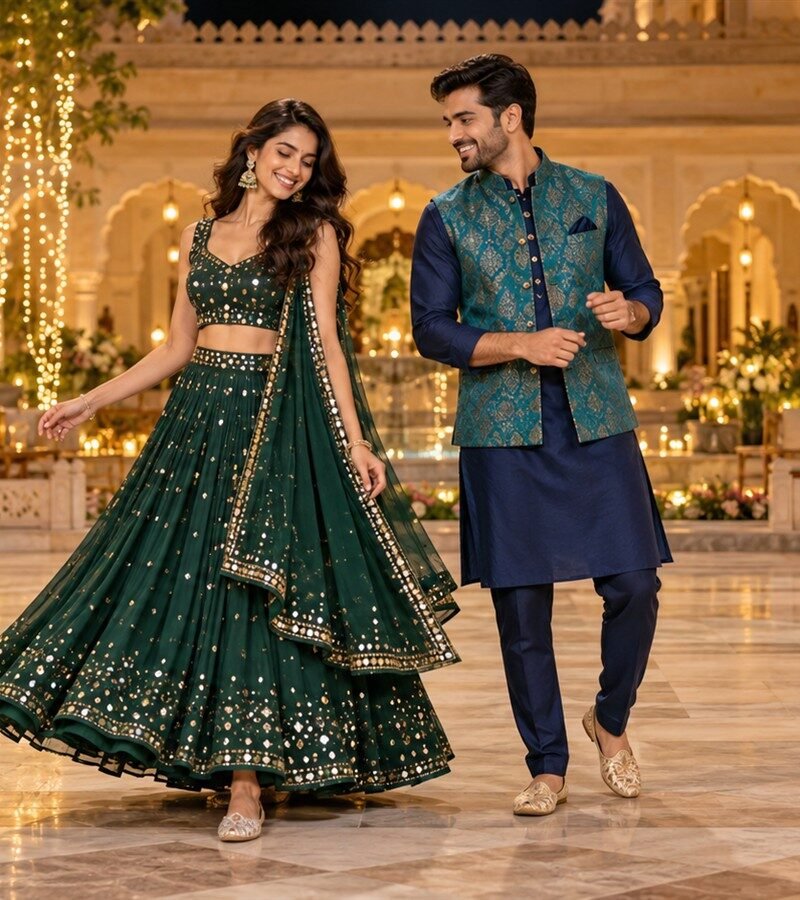
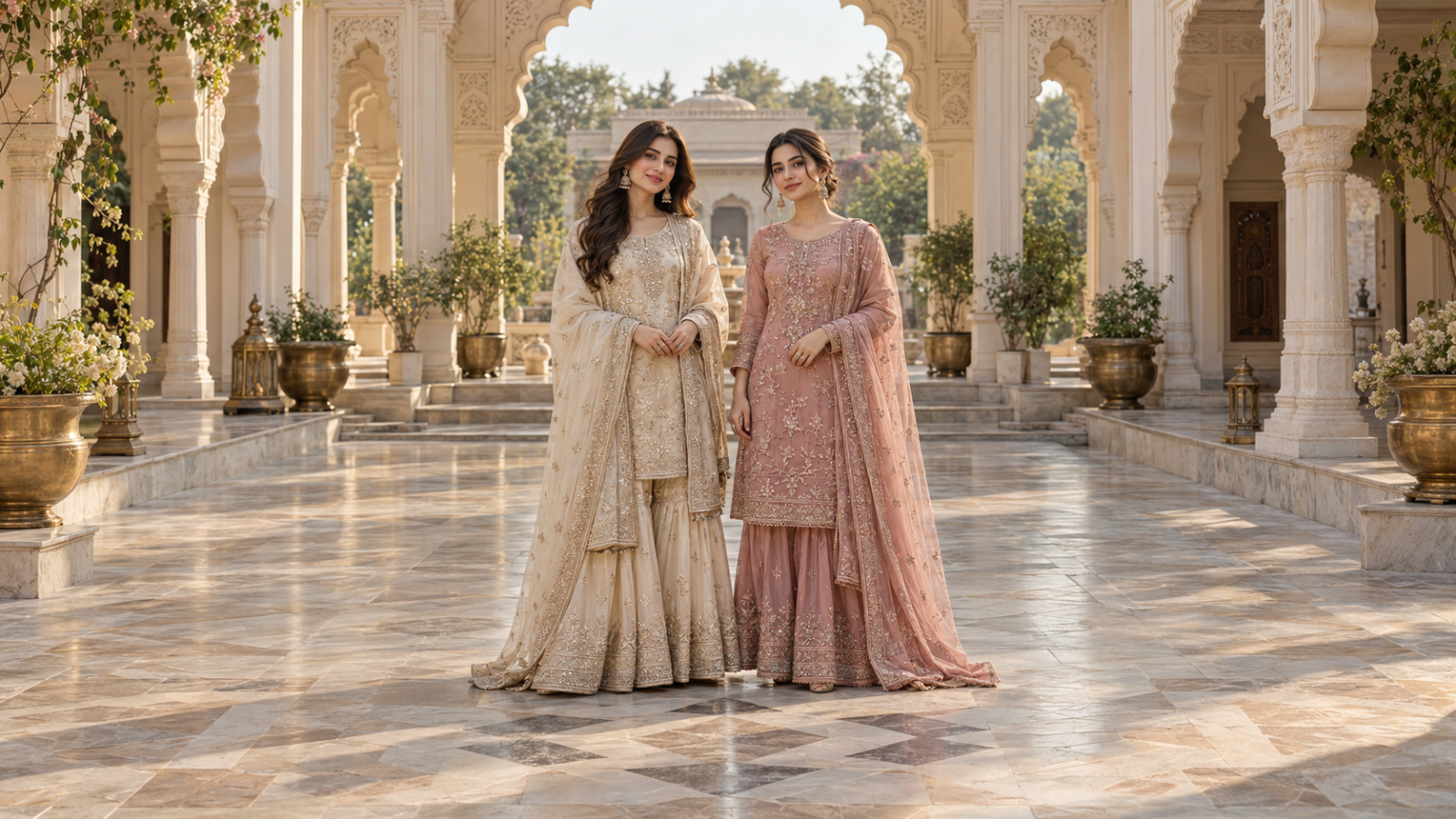

A dupatta is a long scarf, usually around 2.25 to 2.5 metres, worn with shalwar kameez, kurtas, lehengas, shararas and ghararas. How you wear it depends on the outfit and the occasion. For everyday wear, it is usually draped loosely across the chest or over one shoulder. For weddings it is often pleated and pinned. For a nikah, a mosque or a prayer, it is worn over the head.
The simplest drape takes ten seconds and no pins. The most formal ones take a few minutes and three or four. Below are ten drapes, from everyday to bridal, each with steps, the pins you need and what it suits. A drape chooser, fabric guide and fixes for a dupatta that keeps slipping follow.
What is a dupatta?
The word comes from Sanskrit roots meaning “two” and “strip of cloth”. Wikipedia, citing several textile historians, describes the dupatta as an evolution of the uttariya, the shoulder cloth worn in ancient South Asia. It is called a chunni in Punjab and an odhni or orhni in parts of India.
In Pakistan, the dupatta is a standard part of the women’s three-piece outfit: shirt, trousers and dupatta. Pakistani brands still sell many unstitched suits as three pieces, with the dupatta as a separate length of fabric. It serves several purposes at once: it finishes the outfit, it is the main way to cover the head or chest when modesty calls for it, and in bridal wear it often carries the heaviest embroidery in the outfit.
Before you start: length, fabric and pins
- Length. Most dupattas are roughly 2.25 to 2.5 metres long. As one example, Khaadi’s current three-piece unstitched suits list a 2.5 m dupatta. Bridal and lehenga dupattas can be longer and wider. A shorter dupatta limits you to the simpler drapes.
- Fabric. Light fabrics such as chiffon, georgette and lawn flow and gather easily but slip. Stiffer fabrics such as organza, net and silk hold pleats and shape. Heavy fabrics such as velvet and heavily embroidered silk need more pins.
- Pins. Keep four to six small safety pins handy, in a colour close to your outfit. A decorative brooch can replace the pin that shows. Pin through the dupatta into the seam or lining of your shirt, not just the outer fabric.
- Mirror. Use a full-length mirror, and a hand mirror to check the back.
10 ways to wear a dupatta
1. Across the chest (the everyday drape)
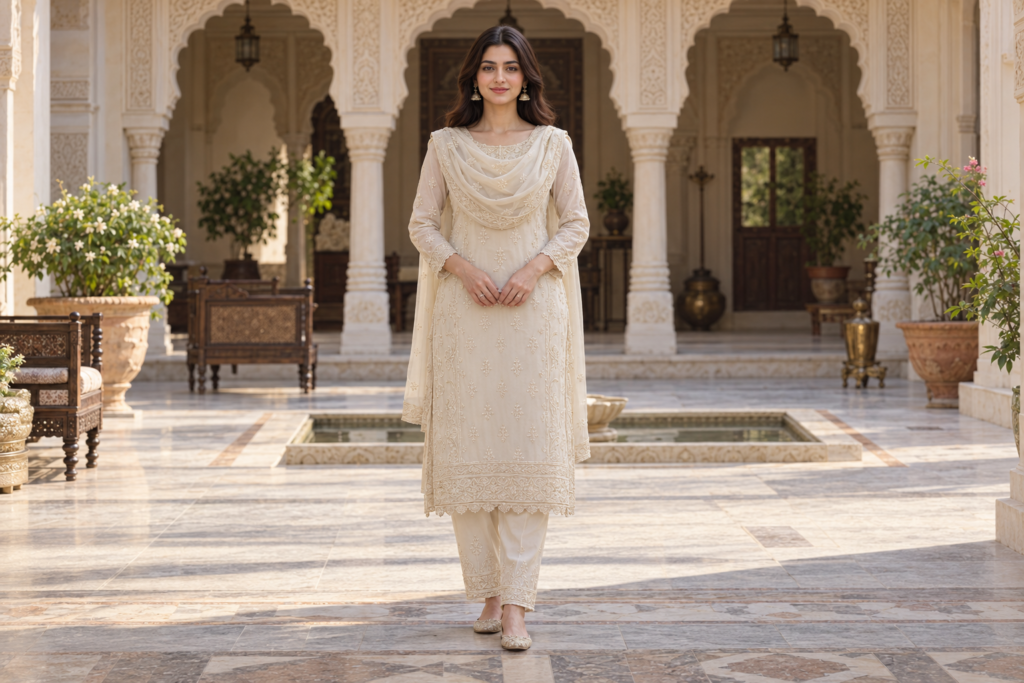
Best for: shalwar kameez, kurtas, everyday wear. Pins: none. Difficulty: easy.
- Hold the dupatta lengthwise and fold it in half lengthwise if it is wide.
- Lay the middle of it across the front of your neck and chest.
- Throw each end back over its shoulder so both ends hang down your back.
- Adjust the front so it sits evenly below your collarbones.
This is the drape you will see most often with shalwar kameez in Pakistan. It covers the chest, leaves the arms free and stays put on most fabrics without pins.
2. Over one shoulder, flowing
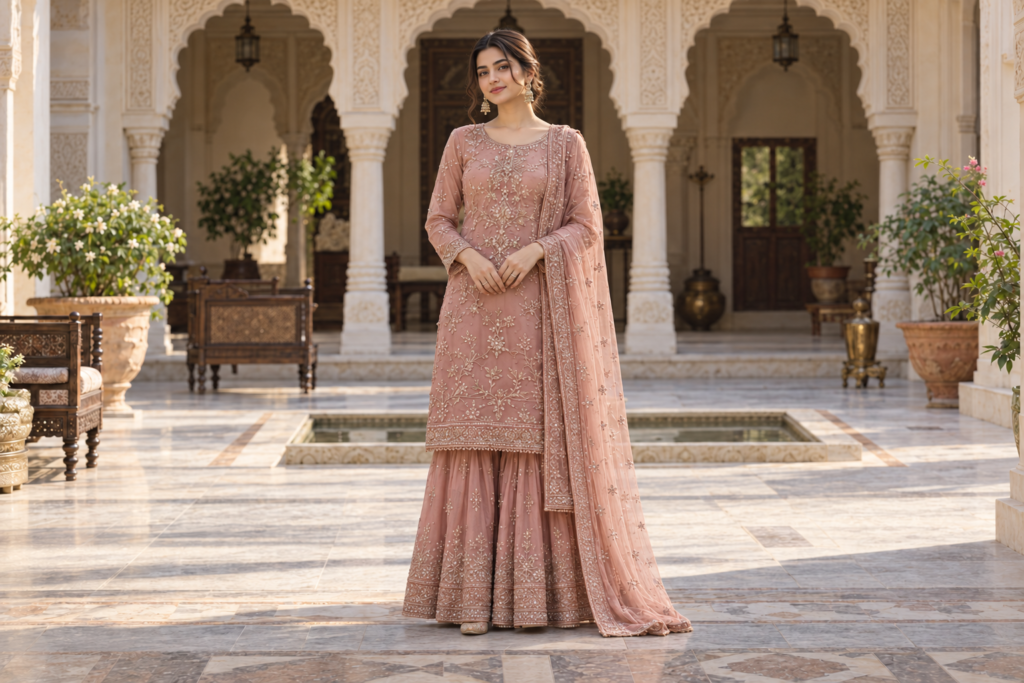
Best for: kurtas, anarkalis, casual and semi-formal wear. Pins: 0 or 1. Difficulty: easy.
- Fold the dupatta lengthwise to about a third of its width.
- Place one end over your left shoulder so about a forearm’s length hangs down the back.
- Let the rest fall loosely down the front.
- Pin at the shoulder seam if the fabric is slippery.
3. Classic pleated one-shoulder drape
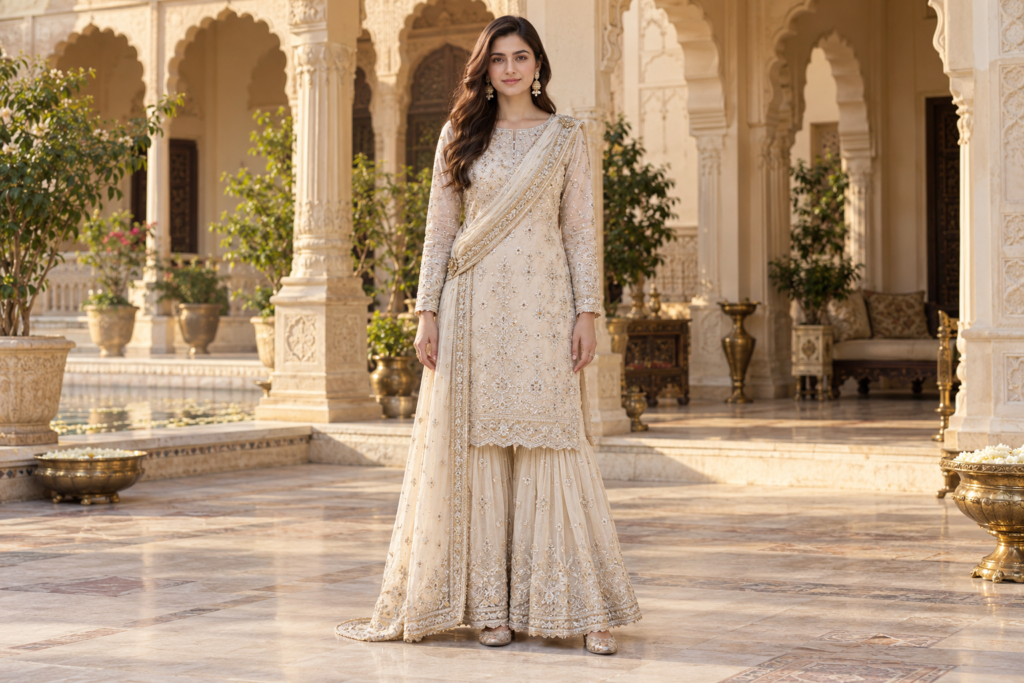
Best for: lehengas, shararas, festive and wedding wear. Pins: 2. Difficulty: medium.
- Pleat the dupatta lengthwise into narrow, even pleats about 3 to 4 cm wide.
- Place the pleats on your left shoulder, leaving about half the length hanging down your back.
- Pin the pleats to your shirt or blouse at the shoulder seam.
- Bring the front end across your body and tuck it into the right side of your waistband, or let it hang free. Pin at the waist if you tuck it.
Wikipedia notes that the left shoulder, with the end tucked at the opposite hip, is the traditional placement in India. It is also the most common way to drape a lehenga dupatta at weddings.
4. Both shoulders, pinned
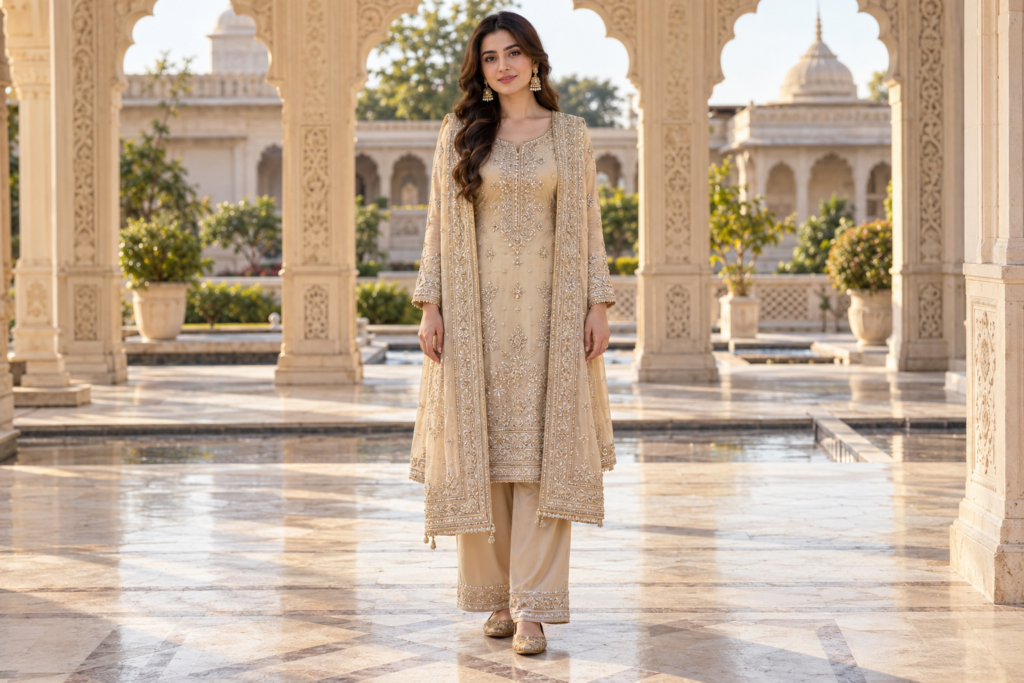
Best for: formal shalwar kameez, sharara and gharara sets, lehengas. Pins: 2. Difficulty: easy to medium.
- Find the middle of the dupatta and hold it behind your back at waist height.
- Bring each side forward over its shoulder so the dupatta forms a U at the back.
- Fold or pleat each side to a neat width where it crosses the shoulder.
- Pin each side at the shoulder seam. Let the ends fall down the front.
This drape shows off an embroidered border along both sides and leaves your chest and the neckline of the shirt visible. It is a common choice with a short kurti and a sharara or gharara.
5. Around the neck, scarf style
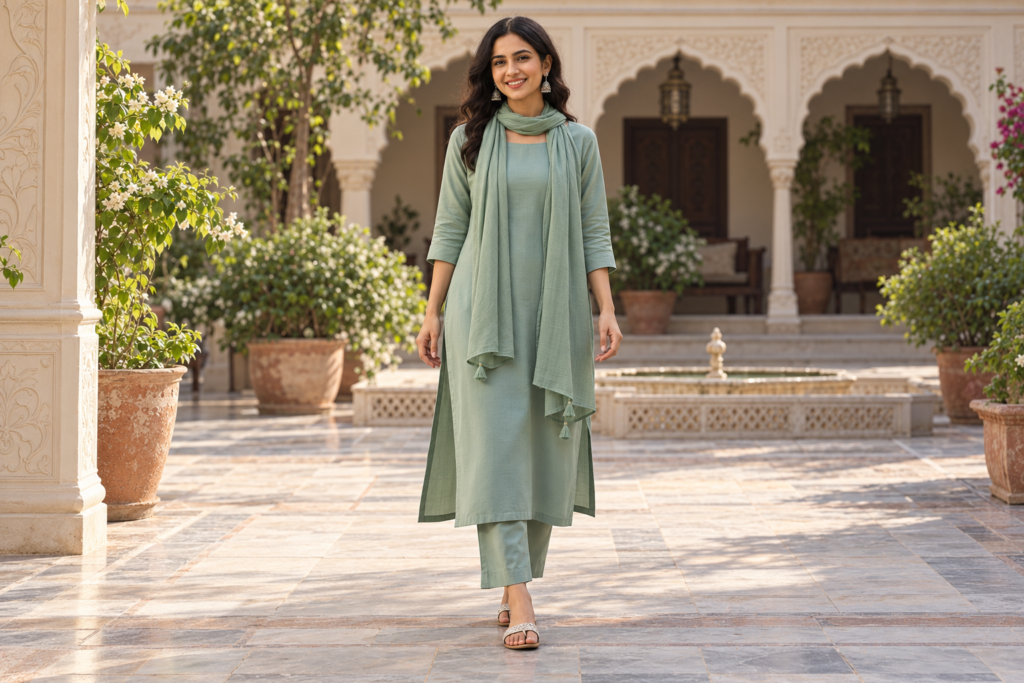
Best for: kurtas with jeans or trousers, travel, cold weather. Pins: none. Difficulty: easy.
- Fold the dupatta lengthwise into a narrow band.
- Wrap it once around your neck.
- Let both ends hang down the front, or throw one end back over the opposite shoulder.
Lawn, cotton and wool-blend dupattas work best; stiff organza does not wrap well.
6. Over the head (simple head drape)
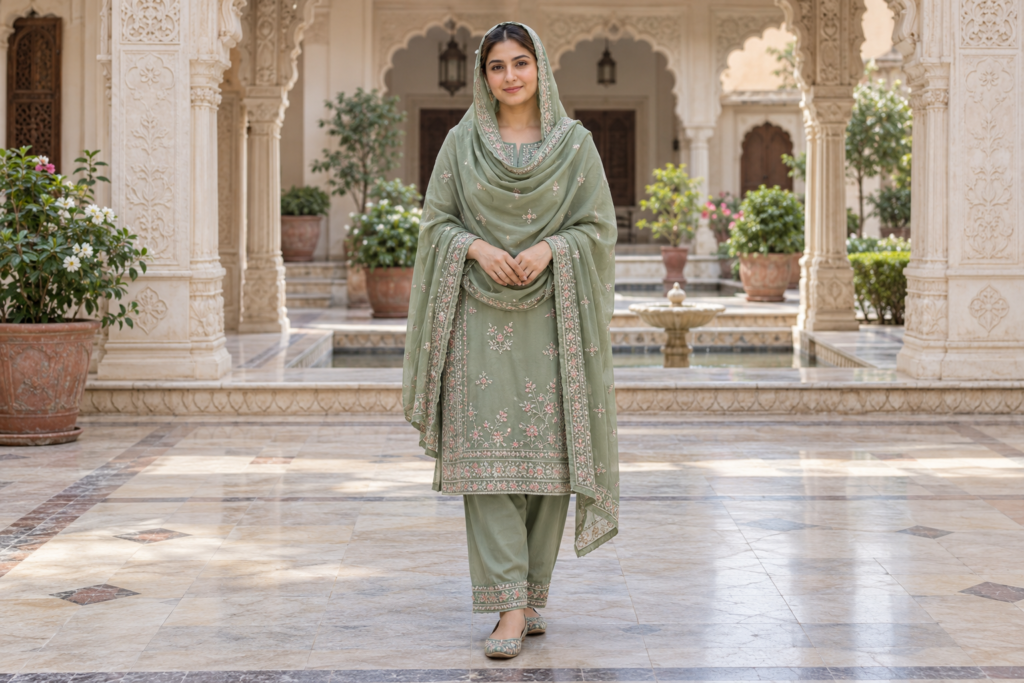
Best for: nikah ceremonies, mosques, prayer, funerals and modest settings. Pins: 0 to 2. Difficulty: easy.
- Drape the dupatta across your chest as in drape 1, with one end longer than the other.
- Lift the middle up over your head so the front edge sits at your hairline.
- Throw the longer end back over the opposite shoulder.
- For a secure fit, pin the dupatta to your hair or to an underscarf at the crown and behind one ear.
Wikipedia notes that women of many religions cover their heads with a dupatta to enter a place of worship. If you are going to a nikah, see our guide to what to wear to a Pakistani wedding for more on dressing for each event.
7. Head and shoulder, pinned (formal head drape)
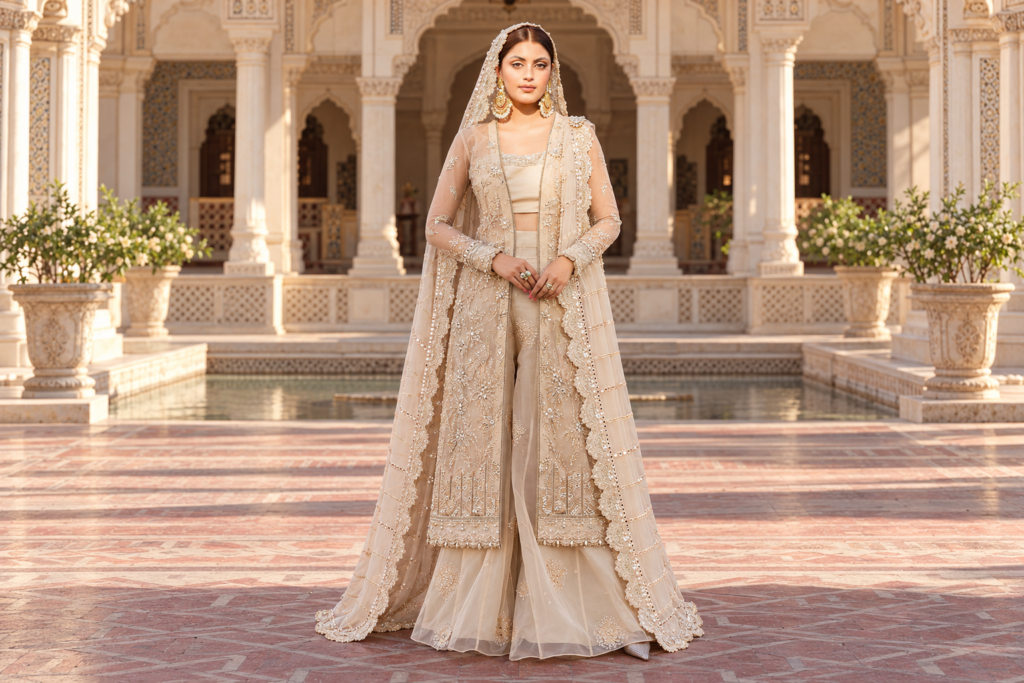
Best for: brides, close family at a nikah or baraat, formal photos. Pins: 3 to 4, plus hairpins. Difficulty: harder.
- Pin one end of the dupatta into your hair at the crown or to the top of a bun, with the embroidered border along your hairline.
- Let the dupatta fall down your back.
- Bring one side forward over your left shoulder and pin it at the shoulder seam.
- Drape the other side down the back or across the right arm, and pin at the elbow if needed.
Heavy bridal dupattas are usually set by a stylist or a family member. For a heavy piece, pin into hair that is already secured with hairpins, not into loose hair.
8. Cape style
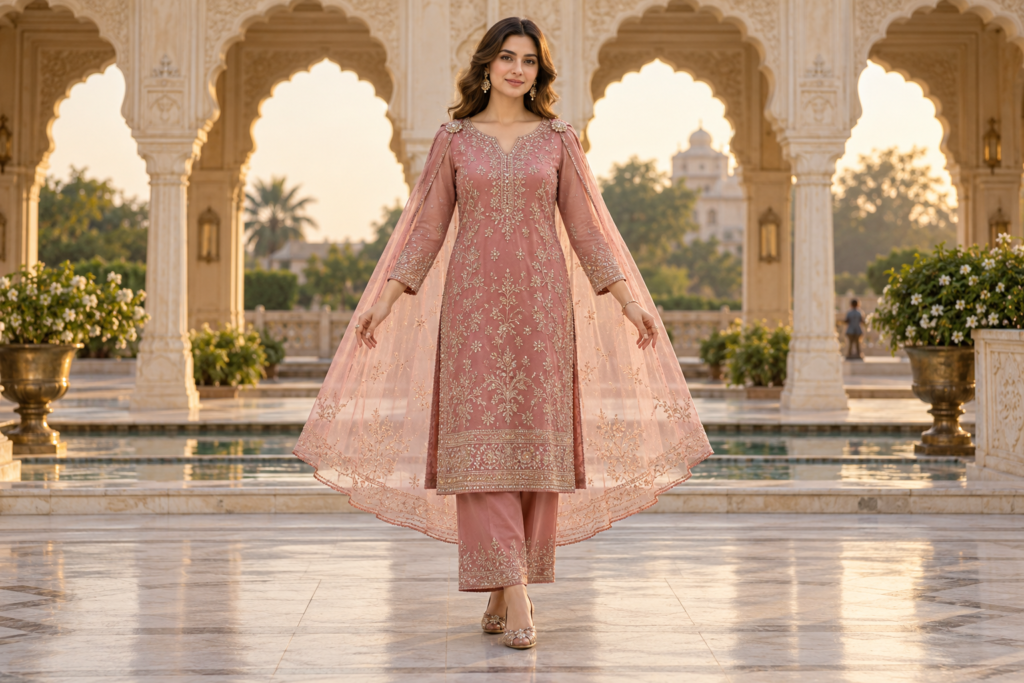
Best for: lehengas and gowns, modern or fusion looks. Pins: 2, or brooches. Difficulty: easy.
- Hold the dupatta horizontally across your back, at shoulder height.
- Bring one corner to the front of each shoulder.
- Pin or brooch each corner at the front of the shoulder.
- Let the rest fall down your back.
Light net and organza dupattas with embroidered borders make the best capes.
9. Belted at the waist
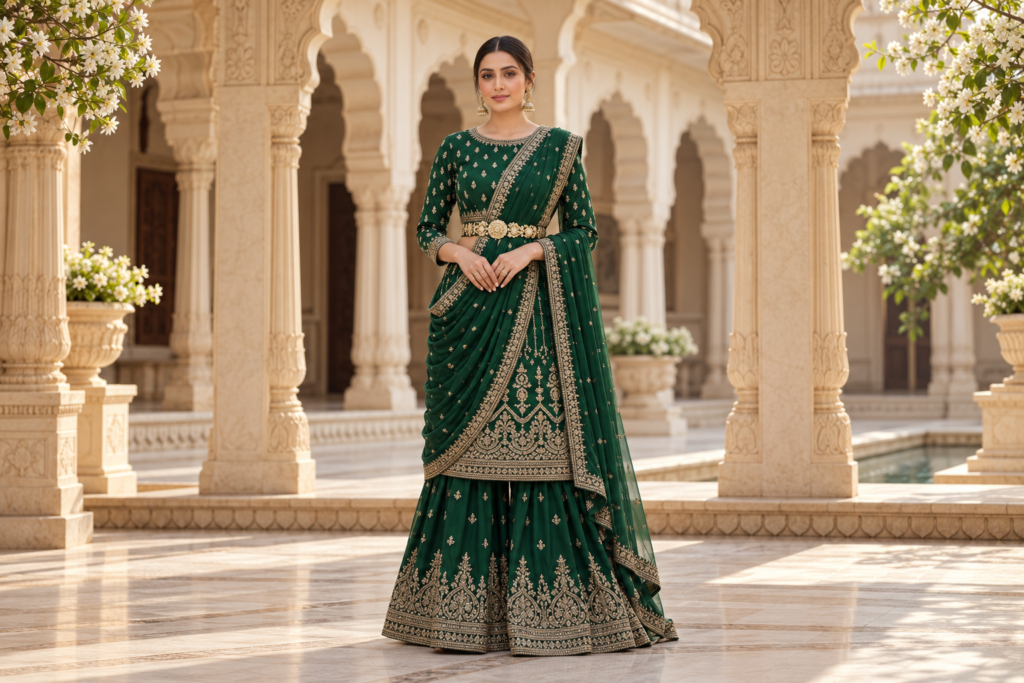
Best for: lehengas, kurtas and dance-heavy events such as a mehndi. Pins: 1 to 2. Difficulty: easy.
- Drape the dupatta over one shoulder (drape 2) or both shoulders (drape 4).
- Gather the front sections neatly at your waist.
- Fasten a belt or kamarband over them at your natural waist.
- Adjust the fabric above the belt so it sits flat.
The belt holds the dupatta in place better than pins alone, which makes this a practical drape for dancing.
10. Over the elbows
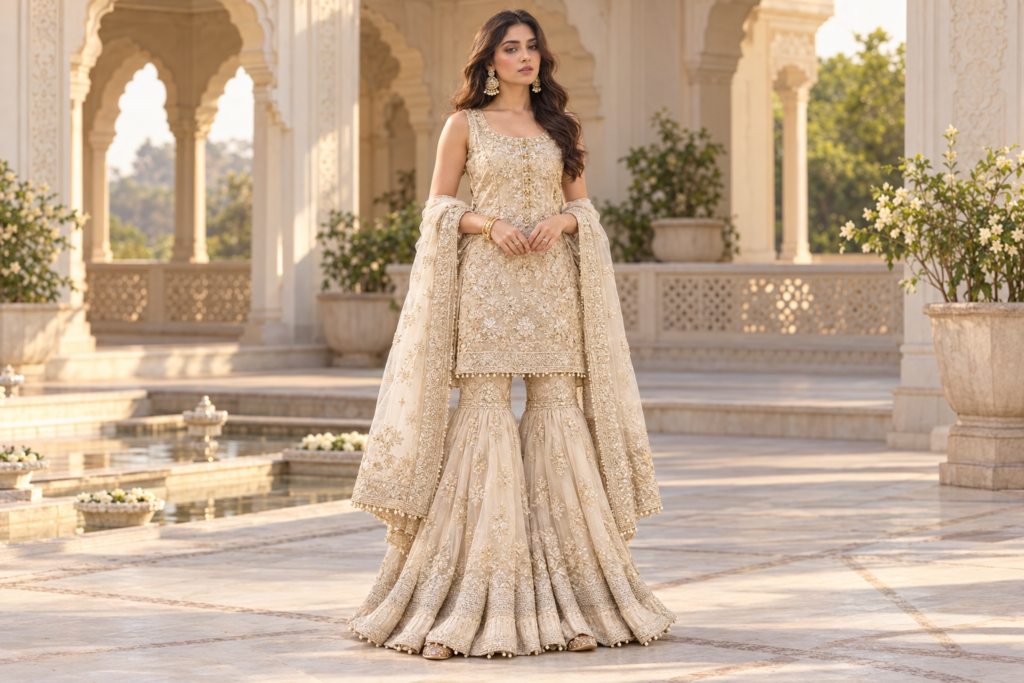
Best for: lehengas, shararas, photos and receptions. Pins: 0 to 1. Difficulty: easy.
- Hold the dupatta horizontally across your back, a little below shoulder height.
- Let it rest in the crook of each elbow.
- Let both ends hang down at your sides.
- Pin at the centre back if you want it to stay level.
It shows off the whole outfit, but it needs your arms in place, so switch to a pinned drape for eating or dancing.
Which drape suits which outfit?
| Outfit | Everyday | Festive or wedding | Modest or religious |
| Shalwar kameez | 1, 2 | 4 | 6 |
| Kurta with trousers or jeans | 2, 5 | 9 | 6 |
| Lehenga | n/a | 3, 8, 9, 10 | 7 |
| Sharara or gharara | 2 | 4, 3, 10 | 6, 7 |
| Anarkali | 2 | 3, 4 | 6 |
Dupatta by fabric
- Chiffon and georgette: soft, flowing and prone to slipping. Best for drapes 1, 2, 6 and 10. Pin through a doubled fold, not a single layer.
- Lawn and cotton: light, breathable, everyday. Best for drapes 1, 2 and 5. They stay put well without pins.
- Organza and net: crisp and light; they hold pleats and shape. Best for drapes 3, 4 and 8.
- Silk and raw silk: medium weight, holds pleats. Best for drapes 3, 4 and 7.
- Khaddar, wool blends and velvet: winter weights. Best for drapes 1, 5 and 6, or as a shawl over the shoulders.
- Heavily embroidered bridal dupattas: heavy, so use more pins and keep the drape simple. Drapes 3, 4 and 7 work best.
How to keep a dupatta from slipping
- Pin to something solid. A pin through the shoulder seam, bra strap or a lining holds; a pin through light fabric alone tears or slides.
- Pin in two places. One pin at the shoulder and a second at the bust or waist stops the dupatta pivoting.
- Fold before you pin. Pleats or a doubled fold give the pin more fabric to grip.
- Use a belt or kamarband (drape 9) when you plan to dance.
- For head drapes, wear an underscarf or a band in a matching colour, and pin the dupatta to it.
- Practise once. Try the drape the day before, then walk, sit and lift your arms.
Frequently asked questions
Which side should a dupatta go on?
For one-shoulder drapes, the left shoulder is the traditional choice, with the loose end crossing to the right hip. It leaves your right hand free. Either side is fine if it suits the outfit or you are left-handed.
How should I carry a dupatta to look slimmer?
No drape changes your size, but some create longer vertical lines. Letting both ends fall straight down the front (drape 4) or a narrow, pleated fall over one shoulder (drape 3) draws the eye up and down. Bulky folds around the neck or waist do the opposite. Choose whatever feels comfortable; there is no body-type rule.
What is the purpose of a dupatta?
It completes the outfit, it provides modesty by covering the chest or head when needed, and in formal and bridal wear it often carries the main embroidery. It also works as a light wrap in cool weather.
How can I style a dupatta in a more modern way?
Cape style (drape 8), belted (drape 9) and scarf style (drape 5) are the most modern options. They also work with fusion outfits such as a kurta with jeans or a gown.
How long is a dupatta?
Usually about 2.25 to 2.5 metres. Khaadi’s three-piece suits, for example, list a 2.5 m dupatta. Bridal dupattas can be longer and are often wider.
How many pins do I need?
None for the everyday drapes, two for most festive drapes, and three to four (plus hairpins) for a formal head drape. Heavy bridal dupattas may need more.
How do I keep a dupatta on my head?
Pin it to an underscarf, a headband or hair that is already secured with hairpins, at the crown and behind one ear. Chiffon slides more than cotton or lawn, so use more pins with it.
Can I wear a shalwar kameez without a dupatta?
Yes. Many women wear kurtas and shalwar kameez without one for casual and work settings, especially outside Pakistan. For weddings, religious occasions and conservative settings, a dupatta is still expected by many families.
The short version
For everyday wear, drape the dupatta across your chest with the ends behind you. For festive and wedding outfits, pleat it over your left shoulder or pin it on both shoulders. For a nikah or a mosque, wear it over your head and pin it at the crown. Match the drape to the fabric, pin through something solid, and practise once before the day.