


What you wear to a Pakistani wedding depends on which event you are attending, because most Pakistani weddings are a series of functions, not a single ceremony. The pre-wedding dholki and mehndi are colourful, relaxed and full of dancing. The nikah, the religious marriage contract, calls for modest dress. The baraat is the most formal evening, and the walima, the reception hosted by the groom’s family, sits somewhere between formal and polished.
For most guests, a good outfit is a long shirt or kurta with trousers or a flared bottom and a dupatta for women, and a kurta, a kurta with a waistcoat or a sherwani for men. Avoid anything that could be mistaken for the bride’s outfit. This guide goes through each event, what men and women typically wear, how to think about colour, and the practical questions guests ask: gifts, weather, renting and covering your head.
Quick guide: what to wear to each event
| Event | What it is | Women | Men | Dress level |
| Dholki | Informal evenings of singing and drumming at the family home in the days or weeks before the wedding | Simple shalwar kameez or kurta with trousers; comfortable for sitting on the floor | Kurta with shalwar or jeans | Casual |
| Mayun or ubtan | A pre-wedding ritual where turmeric paste is applied to the bride or groom | Bright, washable fabrics that won’t show turmeric stains | Simple kurta | Casual to festive |
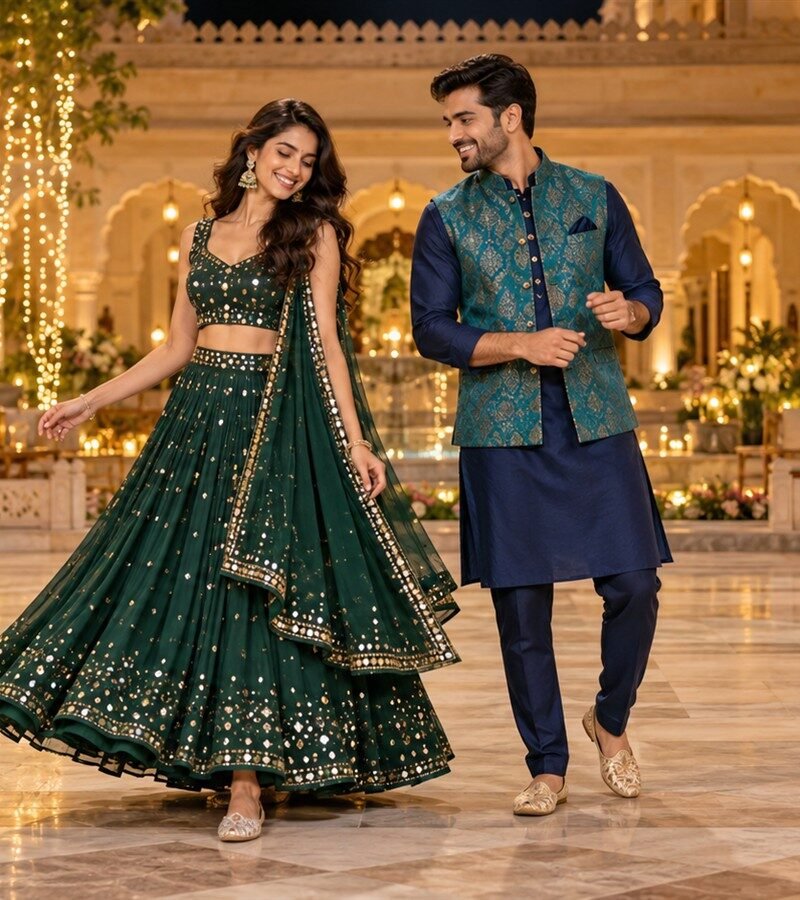
| Mehndi | Henna, music, dance performances | Bright colours; sharara, gharara, lehenga or a flared kurta; light embroidery or mirror work | Kurta, often with a waistcoat | Festive |
| Nikah | The Islamic marriage contract, often held in a mosque, home or venue | Modest, covered outfit; dupatta to cover your head if asked | Kurta shalwar or sherwani; a cap is sometimes offered | Formal and modest |
| Baraat | The groom’s party arrives at the bride’s family’s event; ends with the rukhsati, the bride’s departure | Your most formal outfit; rich fabrics and embroidery; avoid bridal red | Sherwani, prince coat, or kurta with an embroidered waistcoat | Most formal |
| Walima | The reception hosted by the groom’s family after the marriage | Formal but often lighter: softer colours, gowns, sarees, embellished suits | Suit, sherwani or kurta with waistcoat | Formal |
Families combine, rename and skip events, so check your invitation. A nikah is often held on the same day as the baraat.
First, read the invitation
Pakistani invitations usually list each function separately, with its own date, venue and host. Two details on the card tell a guest most of what they need.
- Who is hosting. The mehndi and baraat are traditionally hosted by the bride’s family, the walima by the groom’s family. Some couples hold a joint mehndi or merge events, especially outside Pakistan.
- Which events you are invited to. Close friends and family may be invited to everything. Colleagues and acquaintances are often invited only to the baraat or walima. Dress for the events on your card, not the whole calendar.
If the card mentions a dress code or colour theme, follow it. Mehndi colour themes and “black tie” walimas are both common in the diaspora. When in doubt, ask the person who invited you. It is a normal question, and hosts would rather you ask than guess.
Dholki, mayun and mehndi: what to wear

These are the pre-wedding events, and they are the least formal and most colourful part of the wedding.
A dholki, named after the dholak drum, is a gathering of family and friends to sing wedding songs, often at home. Wear something you can sit on the floor in for a few hours: a cotton or lawn shalwar kameez, a kurta with straight trousers or a simple printed suit.
The mayun, also called ubtan or batna, is a ritual in which family members rub a turmeric paste onto the bride’s or groom’s face, arms and legs. If you are invited, assume turmeric will be close by. Choose a fabric you can wash and colours that will not show a yellow stain.
The mehndi is the big pre-wedding party, named after the henna applied to the bride’s hands and feet. Expect music, choreographed dance performances by friends and family, and a lot of movement. This is the event for colour: yellow, green, orange, pink and other saturated shades are typical. Good choices for women include:
- a sharara or gharara with a short kurti;
- a light lehenga or flared skirt with a kurti;
- a long, flared kurta (a frock or peshwas) with churidar or straight trousers;
- mirror work, gota and thread embroidery rather than heavy stones.
If you plan to join a dance, try the outfit on and move in it beforehand. Wide hems and long dupattas are easy to step on.
Nikah: what to wear

The nikah is the religious heart of a Muslim wedding: a contract in which the bride and groom each accept the marriage in front of witnesses, and the mahr, a gift the groom is required to give the bride, is agreed. It may be held in a mosque, at home or at the start of the baraat or another event.
Dress more modestly than you would for the party events.
- Women: choose an outfit that covers your arms and legs, with a dupatta you can use to cover your head if the ceremony is in a mosque or if the family asks. Pastels, ivory-adjacent shades, soft greens and muted metallics are common, but follow the family’s lead.
- Men: a kurta shalwar, a kurta with a waistcoat, or a sherwani. In a mosque you will remove your shoes, so wear shoes that are easy to take off and socks without holes.
Some families seat men and women separately for the nikah, or for the whole event. Nothing you wear needs to change for that, but it is useful to know when you arrive with a partner.
Baraat: what to wear
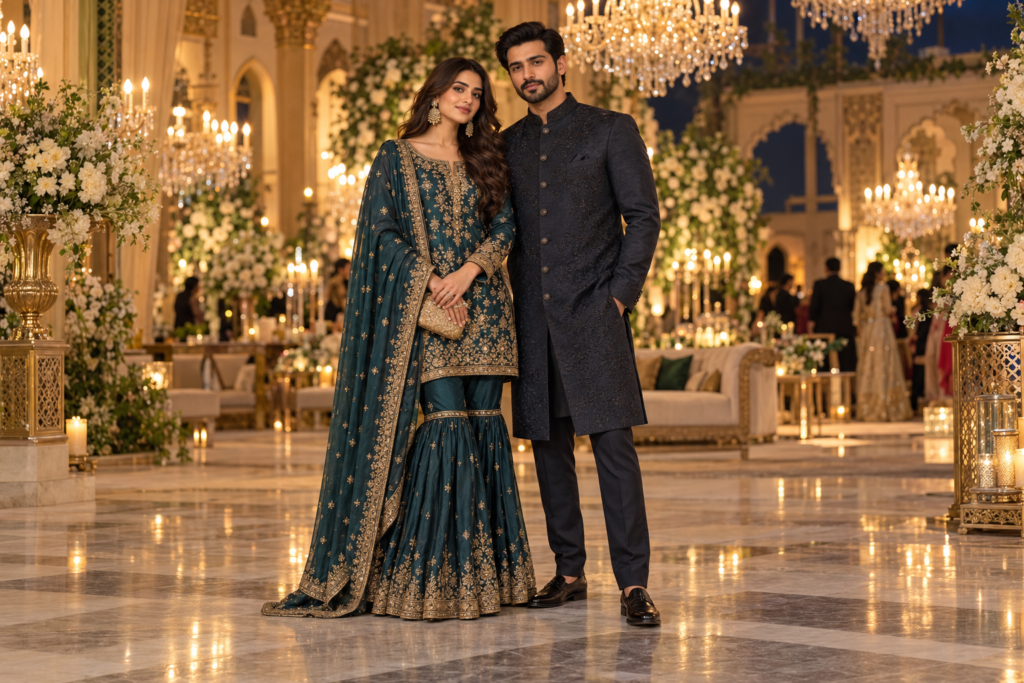
The baraat is the main wedding event and the most formal one. The groom arrives with his family and friends, the couple are seated together on stage, and the evening ends with the rukhsati, when the bride leaves her parents’ home with her new family. It is usually an emotional moment.
This is the night for your most formal outfit. For women, that means rich fabrics such as silk, velvet, jamawar, raw silk or organza; heavier embroidery; and silhouettes such as a long kameez with sharara or gharara, an anarkali, a lehenga or a saree. Jewel tones and deep shades suit the event.
The one thing to avoid is looking like the bride. Red has long been the traditional bridal colour in Pakistan. Dawn described it as “the most popular colour of preference” for brides, and a 2021 Dawn Images report noted a deep red “usually reserved for the baraat”. Plenty of brides now wear other colours, so the safer rule is: no head-to-toe red, and nothing as heavily embellished as a bridal outfit.
For men, the baraat is where a sherwani makes most sense. The sherwani is often described as Pakistan’s national dress for men, and it is widely worn as a wedding outfit. A prince coat or an embroidered waistcoat over a kurta shalwar are lighter alternatives. Grooms often wear cream, gold or ivory sherwanis, so male guests may prefer a darker or contrasting colour.
Walima: what to wear
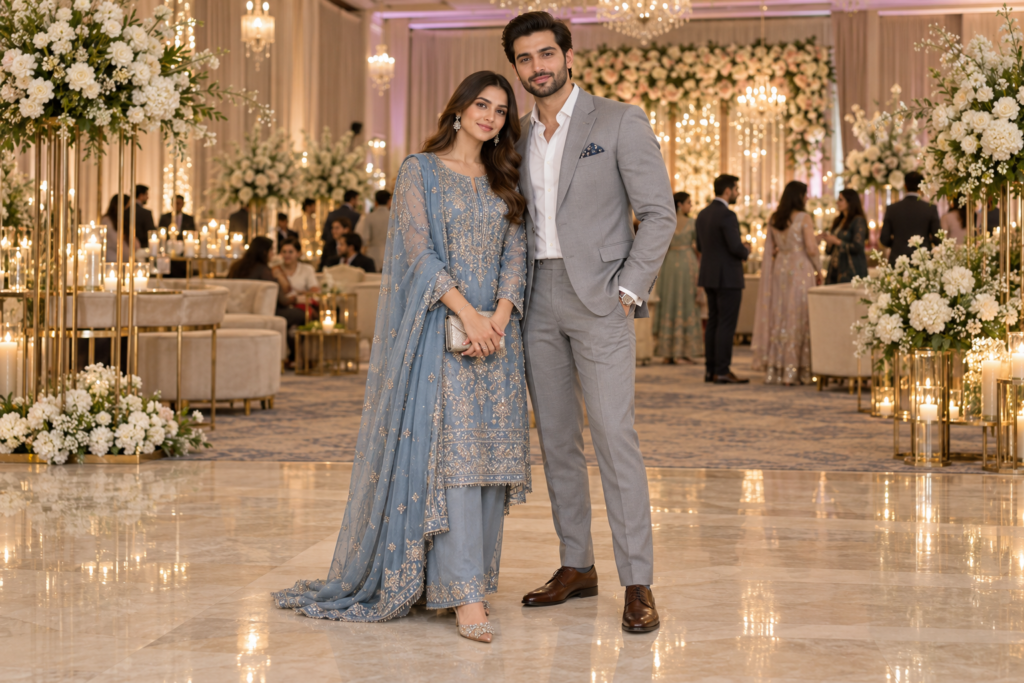
The walima is the wedding feast hosted by the groom’s family once the couple are married. It has a religious basis: in a hadith recorded in Sahih al-Bukhari, the Prophet Muhammad tells a newly married companion, “Give a banquet, even if with one sheep.” Most scholars regard it as a recommended practice rather than an obligation.
In practice, the walima is a formal dinner reception, and it is often more contemporary in style than the baraat. Women often wear softer shades such as pastels, champagne, silver and dusty pink; embellished suits, gowns, sarees or fusion pieces all work. Men often wear a suit, sometimes with a pocket square or a small Eastern detail, or a sherwani or kurta with a waistcoat. The bride often wears a lighter colour at the walima, so check that your outfit is not in the same territory as hers.
What men should wear?
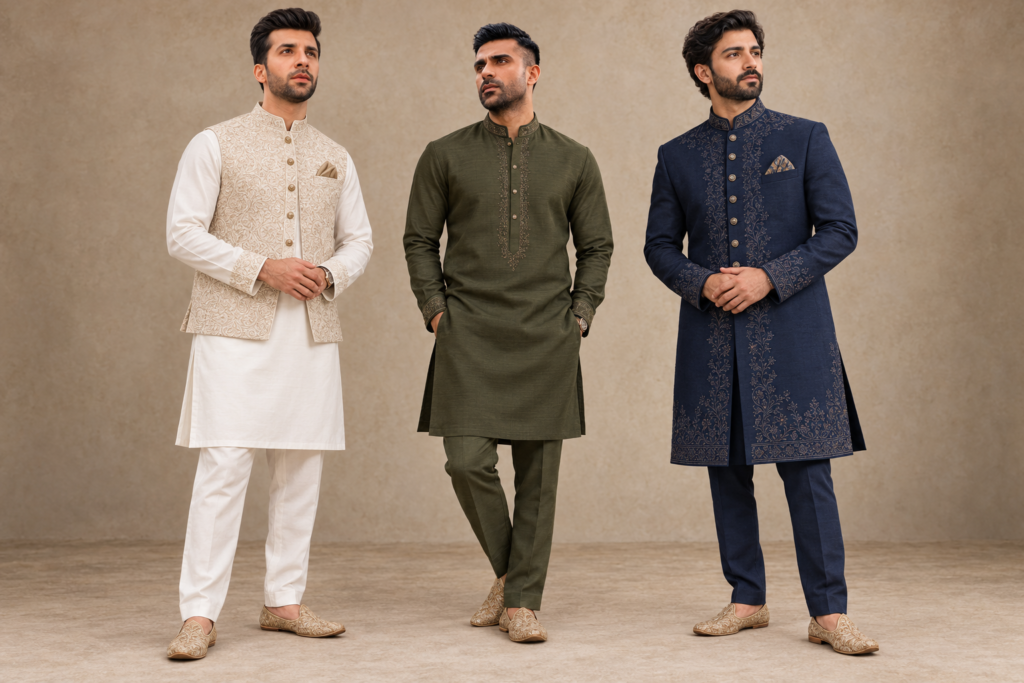
Men’s options are simpler than women’s but follow the same logic: the more formal the event, the more structured the outfit.
- Kurta with shalwar or trousers: right for the dholki, mayun and mehndi. Cotton for daytime, silk or a blend for evening.
- Kurta with a waistcoat: the most versatile option, suitable for the mehndi, nikah, baraat and walima. Choose a plain kurta with an embroidered or textured waistcoat.
- Sherwani or prince coat: best for the baraat. Close family members are more likely to wear these than other guests.
- Suit: widely worn at the walima, especially in the diaspora, and acceptable at the baraat if you have no Eastern formalwear.
- Shoes: khussa or Peshawari chappal with Eastern wear; formal leather shoes with a suit.
If you are not South Asian and are unsure whether wearing a kurta or sherwani is welcome, it almost always is. Hosts generally take it as a sign that you have made an effort. Ask the person who invited you if you want reassurance.
Colours and modesty: conventions, not religious rules
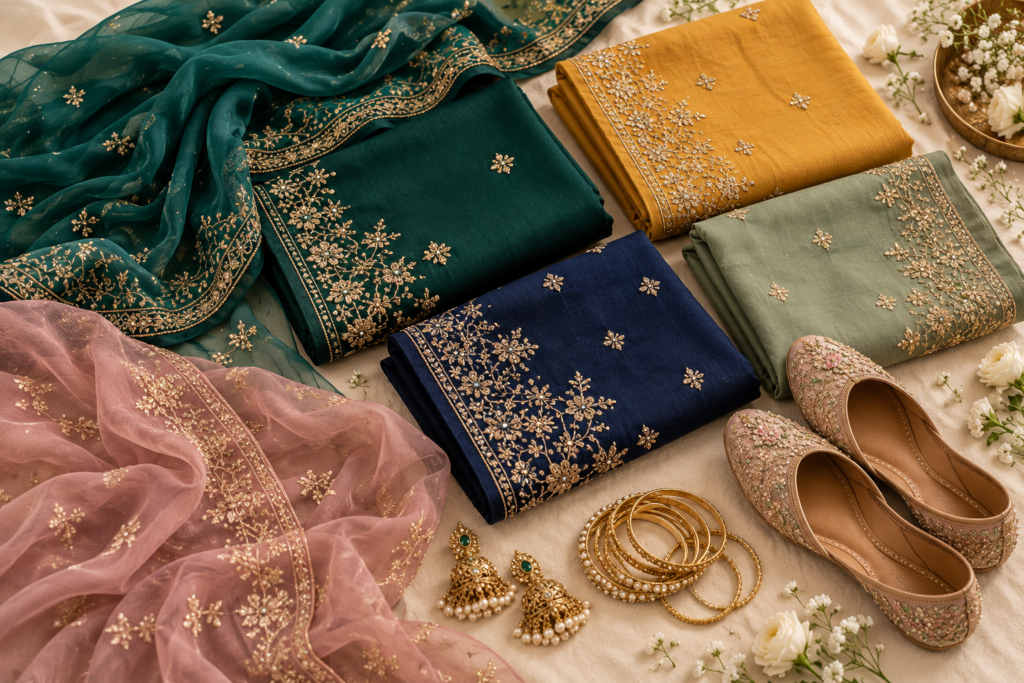
Many guides present colour “rules” for Pakistani weddings. There is no Islamic rule about the colours guests wear. What exists is a set of social conventions, and families differ. The conventions most hosts would recognise:
- Bridal red belongs to the bride. Avoid all-red outfits, particularly at the baraat.
- Match the mood of the event. Bright colours at the mehndi, deeper and richer shades at the baraat, and softer shades at the walima are the usual pattern, not a requirement.
- White and black. Plain white is associated with mourning by some families, and all-black outfits are seen by some as too sombre for a celebration. Both are also worn, especially in the diaspora and at walimas. If you want to wear either, add colour or embellishment, or ask the host.
- Modesty. Most Pakistani weddings expect covered shoulders and longer hemlines. A dupatta is the simplest way to cover up when you need to, and it is part of most women’s outfits anyway. See our guide to how to wear a dupatta.
When the family has set a colour theme for an event, that overrides all of the above.
Dressing for the weather
In Pakistan, the busiest wedding season is winter. Associated Press reporting from Karachi in February 2024 described winter as the season when weddings fill the calendar, with guests attending many functions for a single wedding. Evenings in the north can be cold, especially at outdoor events, and many venues are outdoor marquees or lawns. Velvet, khaddar, karandi and jamawar are common winter fabrics; a pashmina or shawl is useful, and a heavy dupatta can double as one.
In the UK, US and Canada, many weddings take place in banqueting halls, hotels or marquees, often in cold or wet weather. Plan for the walk from the car park: a long coat that does not crush embroidery, closed shoes to change out of, and a fabric that will survive rain. Chiffon and organza look light but can be layered; velvet is a practical winter choice.
Summer weddings anywhere suit cotton, lawn, chiffon and silk blends in lighter colours. Avoid heavy embroidery for outdoor daytime events.
Event timing in Pakistan
If you are attending a wedding in Punjab, it helps to know that wedding functions at venues are regulated by the Punjab Marriage Functions Act 2016. The law restricts how much food a host may serve, commonly known as the one-dish rule, and limits how late events at wedding halls may run. It is enforced: in October 2025 Lahore’s district administration sealed nine marriage halls and fined venues for breaking the one-dish rule and staying open past the permitted time, Dawn reported. For guests, that mainly means the event may end at a fixed time, so check timings with your hosts and avoid arriving very late.
Buying, renting or borrowing
Most guests need several outfits, and the costs add up. Some options:
- Borrow from friends or family. Common and accepted, especially for the mehndi.
- Buy ready-to-wear (pret). Pakistani brands sell festive pret and unstitched fabric. Unstitched pieces need tailoring time, often several weeks in wedding season, so order early.
- Rent. Rental services for South Asian formalwear exist in the UK, US and Canada. Check the condition, the return date and whether alterations are allowed.
- Re-wear across weddings. A good kurta with interchangeable dupattas, waistcoats or bottoms can cover several events.
Whatever you choose, try it on with your shoes and jewellery before the day.
Etiquette: gifts, shoes and photos
Gifts. Cash is the most common gift. It is given to the couple, usually in an envelope, and is known as salami. In 2025, ARY News reported a Karachi wedding where guests could give salami by scanning a Raast QR code instead of handing over envelopes. Gift registries are less common, but some diaspora couples use them; follow what the invitation says. Close family may give jewellery or clothing.
Shoes. You will remove them at a mosque and often in homes during a dholki. Choose shoes you can take off and put on quickly.
Photos. Ask before posting photos of the bride or of women at segregated events, as some families prefer privacy.
Arrival. At a nikah, arrive on time. At large evening events, the main moments, such as the baraat’s arrival and the rukhsati, can run later than the printed time, so ask the family when they plan to start.
Before the day: a guest checklist
- Which events am I invited to, and who is hosting each one?
- Is there a colour theme or dress code?
- Is the nikah in a mosque? (Bring a dupatta or headscarf; wear easy shoes.)
- Indoor or outdoor? (Plan layers for winter.)
- Have I tried on the full outfit, shoes included, and moved in it?
- Have I prepared a gift or envelope?
Frequently asked questions
What should a guest wear to a Pakistani wedding?
It depends on the event. Bright, festive Eastern wear for the mehndi, a modest outfit for the nikah, your most formal outfit for the baraat and a polished, often softer look for the walima. For women, a kameez or kurta with trousers or a flared bottom and a dupatta works almost everywhere; for men, a kurta with a waistcoat does the same.
What is a traditional Pakistani wedding guest dress?
For women, a shalwar kameez or a long shirt with sharara, gharara or churidar, worn with a dupatta. For men, a kurta shalwar, often with a waistcoat, or a sherwani at the baraat.
What is a simple dress for a wedding in Pakistan?
A well-cut shalwar kameez in a good fabric, such as chiffon, silk or a light embroidered lawn for summer, or khaddar or velvet for winter, with a matching dupatta. Simple outfits work at the dholki and as a modest choice for the nikah.
Can I wear Western clothes to a Pakistani wedding?
Yes, at many events, especially the walima and diaspora receptions, as long as the outfit is modest and formal enough. A long dress with covered shoulders or a suit for men is widely accepted. Eastern wear is usually appreciated at the mehndi and baraat.
What colours can’t you wear to an Islamic wedding?
Islam sets no colour rule for wedding guests. Avoid looking like the bride, which at a Pakistani baraat usually means avoiding all-red outfits, and be cautious with plain white or all-black, which some families associate with mourning. Follow any colour theme on the invitation.
What should a man wear to a Pakistani wedding?
A kurta with shalwar or trousers for the mehndi, a kurta with a waistcoat or a sherwani for the nikah and baraat, and a suit or sherwani for the walima.
Do I need to cover my head?
At a nikah in a mosque, yes, if you are a woman. At other events, it is your choice, though some families prefer it during the nikah wherever it is held. Carrying a dupatta covers both cases.
Do you bring a gift to a Pakistani wedding?
Yes. Cash in an envelope, known as salami, is the most common gift. Some couples now accept digital transfers, and some diaspora couples have registries.
Is it okay for a non-Pakistani guest to wear Pakistani clothes?
Generally, yes. Hosts usually welcome it. Avoid bridal-looking outfits, and ask the family if you would like help choosing.
The short version
Dress for each event, not for the wedding as a whole: bright and comfortable for the dholki and mehndi, modest for the nikah, your most formal outfit for the baraat and polished for the walima. Avoid anything that could be mistaken for the bride’s outfit, keep a dupatta to hand, and ask your hosts when in doubt.

2 comments